
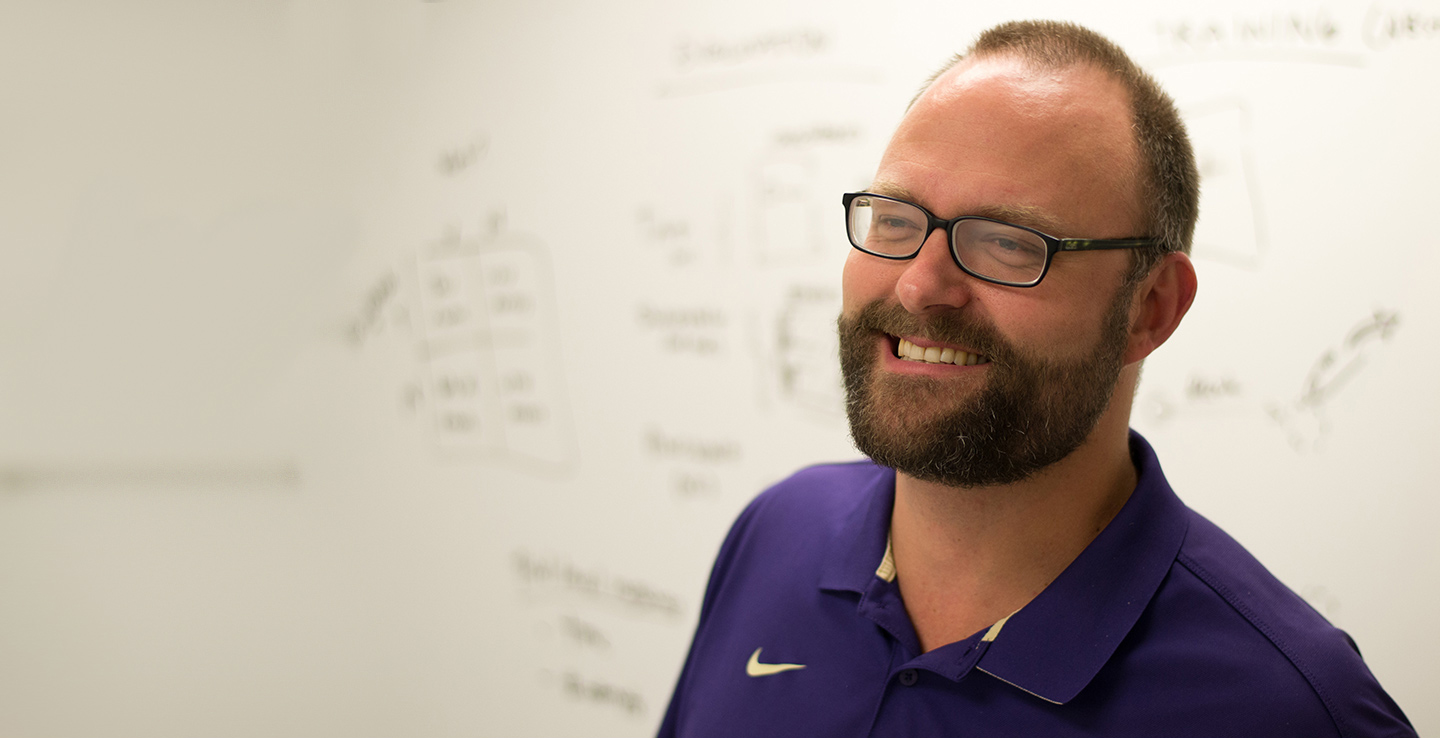
Jacob O. Wobbrock is a Professor of Information and, by courtesy, of Computer Science & Engineering at the University of Washington (UW). He directs the ACE Lab and is an Associate Director and former founding Co-Director of the UW Center for Research and Education on Accessible Technology and Experiences (CREATE). Since 2001, his research has pursued accessible interaction techniques, adaptive user interfaces, mobile accessibility, and human-centered artificial intelligence. Wobbrock received the 2017 SIGCHI Social Impact Award, was inducted into the CHI Academy in 2019, and was named an ACM Fellow in 2021 “for contributions to human-computer interaction and accessible computing.”
Wobbrock began his work in accessible computing during his doctoral studies in human-computer interaction at Carnegie Mellon University. His dissertation introduced EdgeWrite, a text-entry technique designed for people with motor impairments, especially for users whose tremor or limited dexterity made stroke-gesture recognition and tiny mobile keyboards difficult to use on Palm PDA devices. EdgeWrite enabled stable, accurate stylus movements along the edges and corners of a square plastic template using a custom letter-like alphabet. Wobbrock then adapted EdgeWrite to touchpads, joysticks, wheelchairs, trackballs, keys, buttons, and eye-trackers. EdgeWrite received best paper recognitions at both ASSETS and CHI, establishing a recurring principle in Wobbrock’s research: begin with what people can reliably do and design interactions around those abilities.
That principle eventually became Ability-Based Design (ABD), the framework for which Wobbrock is best known. Developed over time with Krzysztof Gajos, Shaun Kane, Jon Froehlich, Susumu Harada, and Gregg Vanderheiden, ABD argues that accessibility should focus on abilities rather than on disabilities, expose the hidden “ability assumptions” embedded in technologies, and make systems conform to people rather than requiring people to conform themselves to systems. ABD grew partly from SUPPLE, an early AI system by Gajos, Daniel Weld, and Wobbrock, which automatically generated user interfaces adapted to people’s motor and visual abilities. Wobbrock and his colleagues formalized ABD in a 2011 article in ACM Transactions on Accessible Computing, now the journal’s most-cited paper; in 2018, Wobbrock introduced ABD to a broader audience in Communications of the ACM. Subsequent projects have extended his approach through personalized touch interfaces, situationally aware devices, and the Ability-Based Design Mobile Toolkit (ABD-MT) led by Wobbrock’s student Judy Kong.
Wobbrock’s research also helped demonstrate that modern touchscreens could be accessible to blind people. In 2008, Shaun Kane, Jeffrey Bigham, and Wobbrock introduced Slide Rule, one of the first finger-driven touchscreen screen-readers. At a time when touchscreens were widely regarded as inherently inaccessible for blind people, Slide Rule showed that such users could explore a screen directly with a “reading finger,” navigate and acquire targets using gestures, and receive controllable auditory feedback. Slide Rule’s ideas pioneered interaction techniques later appearing in Apple’s VoiceOver and Android’s TalkBack systems. Slide Rule received the 2019 SIGACCESS ASSETS Paper Impact Award.
The following year, Kane, Chandrika Jayant, Wobbrock, and Richard Ladner published Freedom to Roam, an early interview-and-diary study of how people with visual and motor disabilities use mobile devices in daily life. The study documented the creativity and persistence with which disabled people altered their behavior, environments, and expectations to accommodate inaccessible technologies. These findings helped further motivate ABD’s insistence that technology, rather than users, should bear the burden of adaptation. Freedom to Roam received the 2025 SIGACCESS ASSETS Paper Impact Award.
As concrete examples of ABD, Wobbrock pursued touch-based ABD projects like Smart Touch and Cluster Touch, both led by Martez Mott. Smart Touch used personalized template matching to interpret arbitrary contact patterns—including touches made with multiple fingers, knuckles, or other parts of the hand—and inferred the user’s intended target, allowing people with motor impairments to touch in whatever manner their abilities made comfortable. This work received a CHI 2016 Best Paper Award. Cluster Touch extended this approach to smartphones through a combination of user-specific and user-independent touch models, improving accuracy for people with motor impairments. In both systems, interfaces adapted to a user’s observed touch behaviors rather than requiring a user to perform precise land-and-lift touch actions.
Other accessible computing projects have translated Wobbrock’s ideas into practical tools. The Pointing Magnifier, created with Leah Findlater, Alex Jansen, and Alexis Hiniker, enlarges both a target’s visible appearance and the motor space available for selecting it, replacing the default mouse cursor on Windows systems. This freely available software, which Wobbrock built himself, has been downloaded more than 175,000 times and is included on numerous third-party accessibility freeware sites.
Wobbrock has also substantially advanced research on situational impairments—temporary ability limitations caused by circumstances such as walking, driving, divided attention, encumbrance, inebriation, or having only one hand available. Projects like WalkType, ContextType, GripSense, SwitchBack, and Drunk User Interfaces, led by Mayank Goel and Alex Mariakakis, explored how devices can detect users’ changing situations and adapt interactions accordingly. This work connected accessibility research to the broader idea that everyone’s abilities vary across situations and over time, and accessible design can benefit everyone.
Wobbrock also developed Design for Social Accessibility, led by Kristen Shinohara, which broadened accessibility beyond functional concerns to social ones. Their research showed that assistive technologies can be functionally effective yet socially inaccessible when they stigmatize users, draw unwanted attention, interrupt conversations, or make people feel self-conscious rather than self-confident. Their work articulated principles and design methods for creating technologies that support positive social interactions, preserve users’ dignity and agency, and help people with disabilities participate confidently in social settings.
Another major strand of Wobbrock’s research has examined mobile accessibility at scale. With Anne Spencer Ross, Xiaoyi Zhang, James Fogarty, and others, he adapted ideas from epidemiology to study mobile app accessibility failures in terms of their prevalence across applications and their incidence over time. Their automated analyses of thousands of Android apps showed that missing labels and inaccessible controls were widespread, systemic problems. This research was cited by the U.S. Department of Justice in its 2024 rule establishing web and mobile-app accessibility requirements under the Americans with Disabilities Act.
Most recently, Wobbrock and his students have investigated how artificial intelligence can expand accessibility and help identify inaccessible software. Projects like A11yBoard and SlideAudit, led by Zhuohao Zhang, work towards making digital slides accessible; and ScreenAudit and TaskAudit, led by Mingyuan Zhong, which use large language models to detect screen-reader accessibility errors in mobile apps and websites. Related projects use AI to support accessible data visualizations, digital art, three-dimensional modeling, and code authoring.
Wobbrock also helped co-found CREATE in 2020 and served as one of its inaugural Co-Directors, helping raise more than $5 million and bringing together researchers across computing, engineering, medicine, design, education, and disability studies. CREATE continues to operate successfully under the leadership of Jennifer Mankoff. Wobbrock also enjoys ongoing research collaborations with CREATE researchers including Leah Findlater, James Fogarty, Jon Froehlich, and Richard Ladner.
Above all, Wobbrock regards his most important contribution to accessibility as his students and postdocs. His advisees focused on accessibility have become leading researchers and advocates in academia and industry: Shiri Azenkot, Leah Findlater, Rachel Franz, Krzysztof Gajos, Susumu Harada, Shaun Kane, Martez Mott, Anne Spencer Ross, Ather Sharif, Kristen Shinohara, and Jessica Tran. He also collaborated early on accessibility projects with non-advisees Jeffrey Bigham and Jon Froehlich, today highly accomplished accessibility researchers. Moreover, Wobbrock currently advises 11 Ph.D. students, nine of whom are focused on accessibility, no doubt future members of this list of accomplished names. Wobbrock considers himself deeply fortunate to have worked with such a great group of accessibility advisees, without whom he would not have received this award.

Comments are closed.